For many architecture students in Australia, the pathway seems clear at first: finish university, start working, gain experience, and eventually become a registered architect.
But somewhere between graduation and registration, many students and graduates realise something unsettling — architecture school never really taught them how registration actually works.
Not in practice.
Not in detail.
And certainly not in a way that prepares you for the Australian Architectural Practice Examination (APE).
This gap is not a failure of students. It is a structural gap between architectural education and professional registration in Australia.
Architecture School vs Registration Reality
Australian architecture programs are excellent at teaching design thinking, representation, and conceptual development. Students spend years refining drawings, models, diagrams, and presentations. Crits are intense. Studio culture is immersive. Software skills are developed quickly.
What is largely missing is preparation for the realities of architectural registration.
Most graduates leave university without a clear understanding of:
- how the AACA registration process actually works
- what the National Standard of Competency for Architects really means in practice
- how the logbook is assessed
- how to write a Statement of Practical Experience
- what the APE exam actually tests
- how the registration interview is conducted
These are not minor administrative details.
They define whether — and when — you can legally call yourself an architect in Australia.
The Australian Architectural Registration Pathway Is Not Intuitive
One of the biggest misconceptions is that registration is simply about “working long enough”.
In reality, registration in Australia is a structured assessment of professional responsibility, not just experience.
To become a registered architect, candidates must navigate:
- Practical experience mapped to the National Standard of Competency
- AACA logbook requirements (minimum hours, post-graduation experience, coverage across competency groups)
- A formal Statement of Practical Experience
- The National Examination Paper (NEP) — a scenario-based exam
- A professional registration interview
None of this is taught explicitly at university.
Most graduates only hear about these steps informally — through colleagues, forums, or last-minute advice — often after they have already accumulated years of experience that is difficult to document retrospectively.
The Competency Framework Is the Real Curriculum (But No One Tells You)
The National Standard of Competency for Architects (2021) is the backbone of registration.
Yet many students and graduates encounter it for the first time only when they start their logbook.
Instead of design briefs, the framework talks about:
- professional conduct and ethics
- legal responsibility and duty of care
- risk management
- contracts and procurement
- consultant coordination
- construction-stage services
This is confronting for many graduates because it reframes architecture not as creative output, but as professional accountability.
Architecture school teaches you how to design.
Registration assesses whether you understand what your decisions mean — legally, contractually, and ethically.
Why the APE Exam Feels So Different
The Australian Architectural Practice Examination (APE) is often described as “tricky” or “unexpected”.
That’s because it is not a technical test, and not a design exam.
The NEP focuses on:
- professional judgement
- risk prioritisation
- contractual boundaries
- ethical decision-making
- understanding the architect’s role (and limits)
Many candidates struggle not because they lack knowledge, but because they answer questions from the wrong role — thinking like a builder, project manager, or draftsperson instead of a registered architect.
This is exactly the kind of thinking architecture school does not explicitly train.
Logbooks and Statements: The Hidden Difficulty
Another major shock for graduates is the logbook and Statement of Practical Experience.
On paper, they seem straightforward. In practice, they require:
- selecting the right projects (not all projects)
- demonstrating depth, not just breadth
- clearly explaining your personal role
- aligning experience with specific performance criteria
Many candidates only realise too late that:
- short projects are difficult to justify
- scattered experience is hard to explain
- the interview is shaped entirely by what you include in your statement
Again, this is knowledge gained through experience — not formal education.
Registration Is About Thinking, Not Memorising
One of the most important mindset shifts is this:
Registration is not about knowing everything.
It is about knowing how to act responsibly when you don’t.
Both the NEP exam and the interview consistently reward candidates who demonstrate:
- awareness of uncertainty
- appropriate escalation
- documentation and communication
- respect for professional boundaries
This way of thinking is rarely taught explicitly at university — but it is central to professional practice.
Bridging the Gap Early Makes Everything Easier
The candidates who feel most confident going into the APE are rarely the most senior.
They are the ones who understood the registration framework early.
They:
- logged experience progressively
- recognised which tasks mattered
- understood how daily work mapped to competency areas
- prepared for the exam by understanding why questions are asked, not just what they test
This is not about rushing registration.
It is about aligning experience with expectations.
A Practical Resource for the Registration Pathway
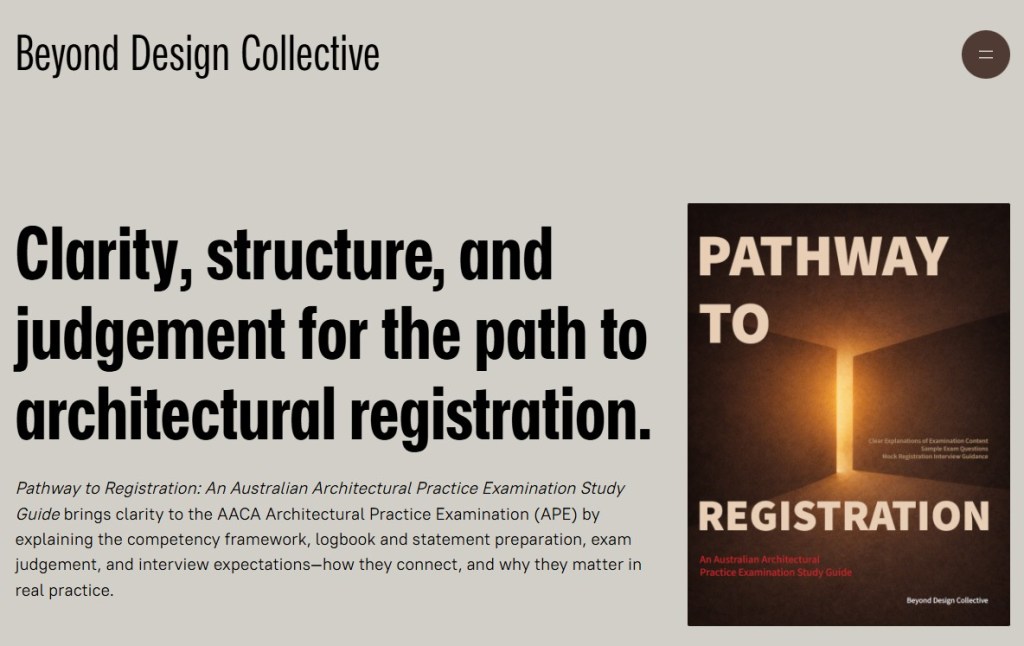
This gap between architecture school and registration is exactly why Pathway to Registration: An Australian Architectural Practice Examination Study Guide was created.
The guide is designed for:
- architecture students who want early clarity
- fresh graduates starting the logbook process
- APE candidates preparing for the exam and interview
It brings together:
- clear explanations of the Australian registration system
- plain-English interpretations of the competency framework
- guidance on logbooks and statements
- NEP-style sample questions with explanations
- a full mock registration interview
Not as a replacement for official AACA material — but as a way to understand how it all fits together in real practice.
Final Thought
Architecture school teaches you how to design buildings.
Registration asks whether you are ready to carry professional responsibility.
That transition is challenging — but it doesn’t have to be confusing.
If you are navigating the Australian architectural registration pathway, understanding it early is the most powerful preparation you can give yourself.

 Beyond Design Collective
Leave a comment