For many architecture graduates in Australia, the Architectural Practice Examination (APE) does not feel like a single exam—it feels like a system.
At the centre of that system sits one document that causes more confusion than almost anything else: the APE Competency Framework, formally known as the National Standard of Competency for Architects.
If you have ever searched for:
- APE competency framework explained
- How does the APE work in Australia?
- How to prepare for architectural registration as a graduate
- What are performance criteria in the APE?
—you are not alone.
This article is written for architecture students, graduate architects, and APE candidates who want a practical, plain-English understanding of how the competency framework actually works, how it connects to real practice, and how to prepare for registration without treating it like a memorisation exercise.
What Is the APE Competency Framework?
The APE competency framework is AACA’s way of defining what a registered architect must be capable of doing in real professional practice.
It is not about design talent.
It is not about software skills.
And it is not a reflection of how “good” you are as a designer.
At its core, the framework answers one question:
Can this person take independent professional responsibility as an architect in Australia?
That responsibility includes legal, contractual, ethical, and risk-based decision-making—often under uncertainty.
This is why many graduates experience a disconnect. Architecture school trains you to design. The APE assesses whether you understand professional consequences.
Why the Framework Feels Overwhelming to Graduates
Most graduates encounter the competency framework after university, usually when someone mentions:
“You’ll need this for your logbook, statement, exam, and interview.”
Suddenly, architecture is described through:
- numbered performance criteria,
- unfamiliar professional language,
- and categories that don’t resemble studio briefs.
This reaction is common—and normal.
The framework is not written to teach you architecture.
It is written to assess readiness for professional responsibility.
Once that mindset shifts, the framework becomes far more readable.
The Four Competency Groups Explained (In Practice)
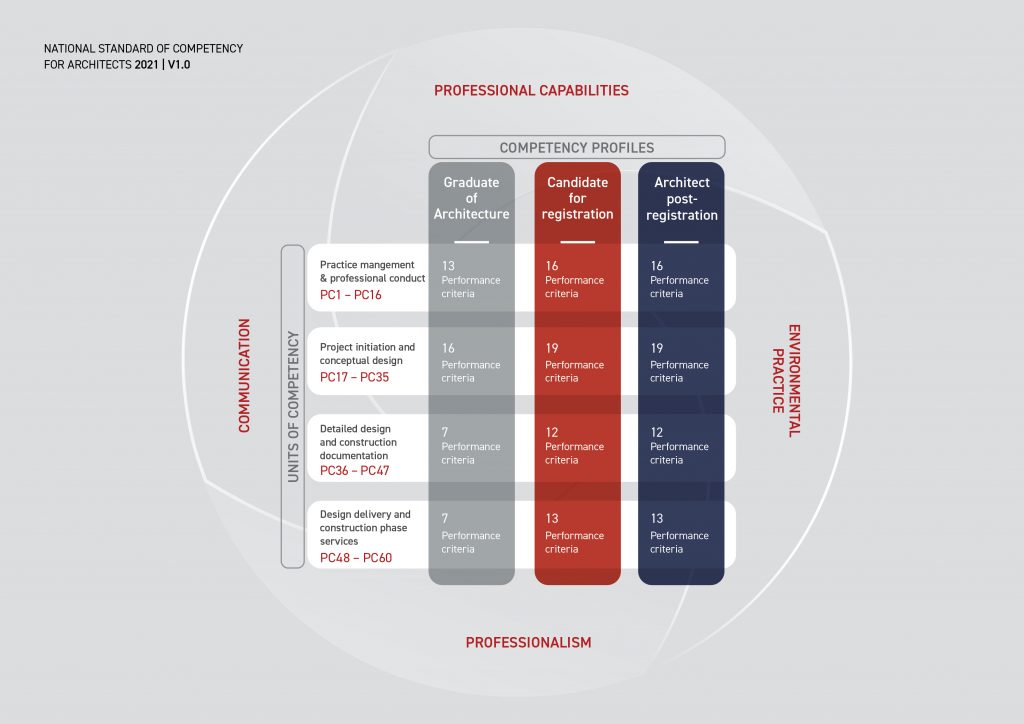
The National Standard of Competency for Architects (2021) groups 60 performance criteria into four areas. You do not need to memorise them—but you do need to understand what each group is really about.
1. Practice Management & Professional Conduct (PC1–PC16)
This group focuses on how architects operate as professionals, not as designers.
It includes:
- ethics and duty of care,
- understanding contracts and fees,
- professional boundaries,
- risk, liability, and communication.
Many graduates underestimate this area because it feels “non-design.”
In reality, this is where registration draws the hardest line between student and professional.
2. Project Initiation & Conceptual Design (PC17–PC35)
This group is the most familiar to graduates.
It covers:
- briefs and client requirements,
- site and planning constraints,
- feasibility and early decision-making.
The difference from university is emphasis:
not how creative the idea is, but how decisions respond to constraints and responsibility.
3. Detailed Design & Construction Documentation (PC36–PC47)
This is where drawings stop being representational and become contractual.
The framework is testing whether you understand:
- coordination with consultants,
- technical compliance,
- accuracy and clarity in documentation.
If you spend most of your day producing drawings, this group probably maps closely to your work—but the why now matters as much as the how.
4. Design Delivery & Construction Phase Services (PC48–PC60)
This group is often the least familiar to early-career graduates.
It covers:
- site inspections,
- RFIs and variations,
- time, cost, and quality management,
- administering contracts during construction.
Registration requires some exposure here because architects are trusted to manage risk after construction begins—not just before.
How the Competency Framework Connects to the APE Process
One of the most misunderstood aspects of the APE is that the same framework underpins every stage:
- Logbook
- Statement of Practical Experience
- National Examination Paper (NEP)
- Registration Interview
Each stage simply tests the framework in a different way.
The exam tests judgement.
The interview tests reasoning.
The logbook and statement test alignment between experience and responsibility.
Understanding this early can save months—sometimes years—of confusion.
You Don’t “Study” the Framework — You Learn to Use It
A common mistake is treating the competency framework like a syllabus.
Graduates try to:
- memorise criteria,
- force-fit experience,
- or prepare only right before the exam.
In practice, the strongest candidates do the opposite:
- they align work experience to the framework early,
- they understand why certain tasks matter,
- and they prepare for the APE as an extension of professional thinking—not an academic test.
This is also why many candidates pass the exam but struggle in the interview: the interview tests understanding, not recall.
Why This Is Rarely Taught at University
Australian architecture schools focus (correctly) on:
- design thinking,
- conceptual development,
- and critical engagement.
What they do not teach—because it sits outside academic assessment—is:
- registration structure,
- professional accountability,
- and how day-to-day work connects to legal and ethical responsibility.
The APE sits precisely in that gap.
Final Thoughts: Registration Is a Journey, Not a Checklist
Understanding the APE competency framework is less about ticking boxes and more about learning how architects think when responsibility matters.
Once you see the framework as a map—rather than a hurdle—the entire registration pathway becomes clearer, calmer, and far more manageable.
Further Reading
For graduates who want a structured, practical guide that brings together:
- competency framework interpretation,
- logbook and statement guidance,
- NEP-style exam questions,
- and mock registration interviews,
Pathway to Registration: An Australian Architectural Practice Examination Study Guide was written specifically to bridge that gap between education and professional registration.

 Beyond Design Collective
Leave a comment